

A road transport risk assessment helps a business connect driving hazards with the decisions that shape daily work. It asks where people could be harmed, which controls already exist and what needs to change before the next journey.
For Malaysian companies managing deliveries, service visits or employee travel, that process can also expose operational weaknesses: unrealistic schedules, recurring vehicle defects, unclear contractor responsibilities and actions that never reach the right owner. Improvements depend on implementing and reviewing the controls identified.
Start with the work your organisation actually performs. Include relevant company vehicles, hired vehicles, contractor arrangements and employees using their own vehicles for business journeys. Agree the boundaries so everyone knows which activities and locations are being reviewed.
The UK Health and Safety Executive groups work-driving risks around the journey, the driver and the vehicle. Its guidance for employers provides a useful organising framework; its legal statements apply to its own jurisdiction and are not Malaysian requirements.
Within that framework, describe specific scenarios. “Transport is dangerous” gives a manager little to act on. “A late delivery schedule leaves insufficient time for the planned route and breaks” identifies a condition that a planner can investigate.
Compare planned journeys with what drivers report experiencing. Include loading time, customer access, congestion, breaks and the work performed between driving periods. A schedule that repeatedly requires exceptions needs review.
For example, a service team might discover that appointment slots allow travel time but omit equipment unloading. Adjusting the booking template can reduce pressure on the next journey and help customers receive more credible arrival estimates. This is an illustrative possibility, not an ADHINS client result.
Look at how reported defects reach maintenance, how replacements are arranged and who authorises release. If the same defect returns, ask whether the cause was resolved and whether the maintenance plan suits the duty cycle.
The operational value is clearer decision-making: dispatch knows which vehicles are available, maintenance knows the priorities and drivers know how to raise a concern. An assessment does not replace a technical inspection or establish that a vehicle is mechanically safe.
Risk often becomes harder to manage when work passes between teams. A planner may assume a contractor briefed its drivers; a supervisor may assume maintenance saw a defect report. Document who checks, who decides and who follows up.
That clarity helps prevent unresolved issues from travelling with the vehicle. It also makes it easier to identify where a workflow needs improvement when a problem recurs.
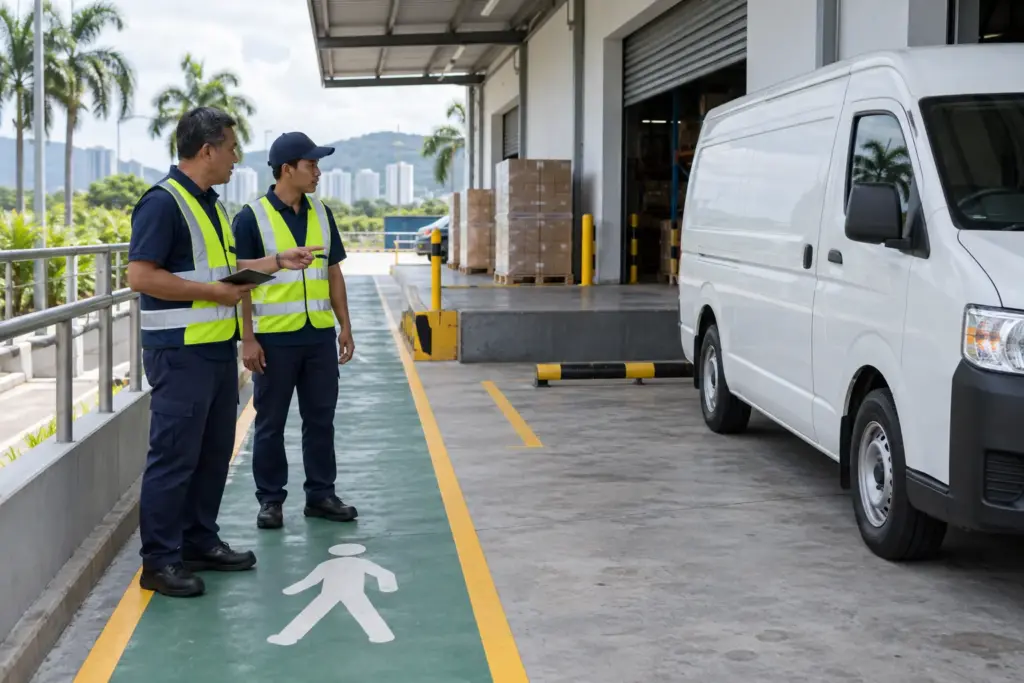
Use evidence to select an action. Unfamiliarity with a vehicle may call for familiarisation and assessment. An unsuitable delivery entrance may require a different access arrangement. A compressed schedule may require replanning.
Training can support capability, but it cannot repair a defective vehicle or remove an unrealistic workload. Match the response to the cause before committing time or budget.
Select a meaningful activity, such as regional deliveries or field-service travel. Talk with drivers, planners, maintenance and supervisors. Review relevant journey records, defect reports, incidents and near misses, and observe how the work happens where appropriate.
State what the evidence does not cover. A review of one depot or one shift should not be presented as proof of conditions across the whole fleet.
Consider drivers, passengers, other road users and people at delivery or customer sites. Write down the hazard, the exposure and the possible consequence. Include changes in weather, workload, vehicle use and site arrangements where relevant.
Check whether a control works in practice. A defect-reporting procedure is weak if reports cannot reach an available decision-maker. A journey plan is incomplete if drivers have no way to escalate a delay.
Use your organisation’s approved assessment method to consider likelihood and severity. Record the reasoning and uncertainty alongside any score. A number alone does not explain whether a control is adequate.
First consider whether unnecessary travel or exposure can be removed. Where the activity remains, select practical changes to the journey, equipment, arrangements or capability. Specify an owner, target date and the evidence needed to show completion.
Urgent concerns need prompt escalation through the company’s process. Do not allow a future review date to postpone a decision about a current serious risk.
Check whether actions have been implemented and whether the intended problem has improved. Revisit the assessment after material changes, incidents or evidence that controls are ineffective, as well as at the planned review point.
The following examples are illustrative. Priorities must be assessed against your actual operation.
| Finding | Possible operational action | Owner | Evidence to review |
|---|---|---|---|
| Loading delays repeatedly compress travel time | Rework departure and appointment planning | Transport planner | Schedule exceptions and driver feedback |
| Defect reports remain unresolved at dispatch | Introduce a visible hold-and-release process | Fleet manager | Outstanding defects and release records |
| Drivers encounter an unsuitable customer entrance | Agree an appropriate access or delivery arrangement | Operations lead | Confirmed site instructions and driver feedback |

Track measures connected to the controls: overdue actions, unresolved defects, recurring schedule exceptions and completed follow-up checks. Define the period and scope consistently so comparisons are meaningful.
Treat incident and near-miss figures carefully. More reports can reflect better reporting, while fewer reports can reflect reduced activity or under-reporting. Where possible, consider exposure such as distance or journeys alongside the figures. Do not attribute a change to the assessment alone without supporting evidence.
IVMS or telematics information can help identify questions for review. Interpret it alongside route conditions, vehicle use and driver input rather than treating an isolated alert as a complete explanation.
A useful assessment produces decisions that people can apply: whether to change a journey, hold a vehicle, revise a site arrangement or provide further support. Put those decisions into the systems used by dispatch, supervisors and maintenance.
ADHINS provides road transport consultation covering fleet planning, risk control and advisory support. Discuss your fleet, operating concerns and desired assessment scope with ADHINS to agree the appropriate work and deliverables.
No. A vehicle inspection focuses on vehicle condition. A road transport risk assessment considers the wider activity, including people, journeys, vehicles and how the work is managed.
Include people who understand the work and can act on findings: drivers, planners, supervisors, maintenance and the accountable manager. Bring in suitable specialist support where the scope requires it.
Yes. A small fleet can use a proportionate review of its actual journeys and controls. The detail should reflect the risk and complexity, not simply the number of vehicles.
No. Applicable requirements need to be checked for the operation, and benefits depend on implementation. A completed document alone does not demonstrate effective controls or a financial result.








©2026 ADHINS Management Sdn Bhd. All Rights Reserved.